Dominion Building
1910Second Empire / Commercial
The first of the boom’s high-rises, at Hastings and Cambie.
Compare its painted steel frame and mansard crown with the Rogers Building’s concrete frame and steel cornice.
Standing
Boomtown Vancouver · 1909–1913
A 25-year-old city spending $1.5 million a month on skyscrapers — and a contractor who arrived on the first train, betting his fortune that it would keep rising.
Building the Boom
The CPR City
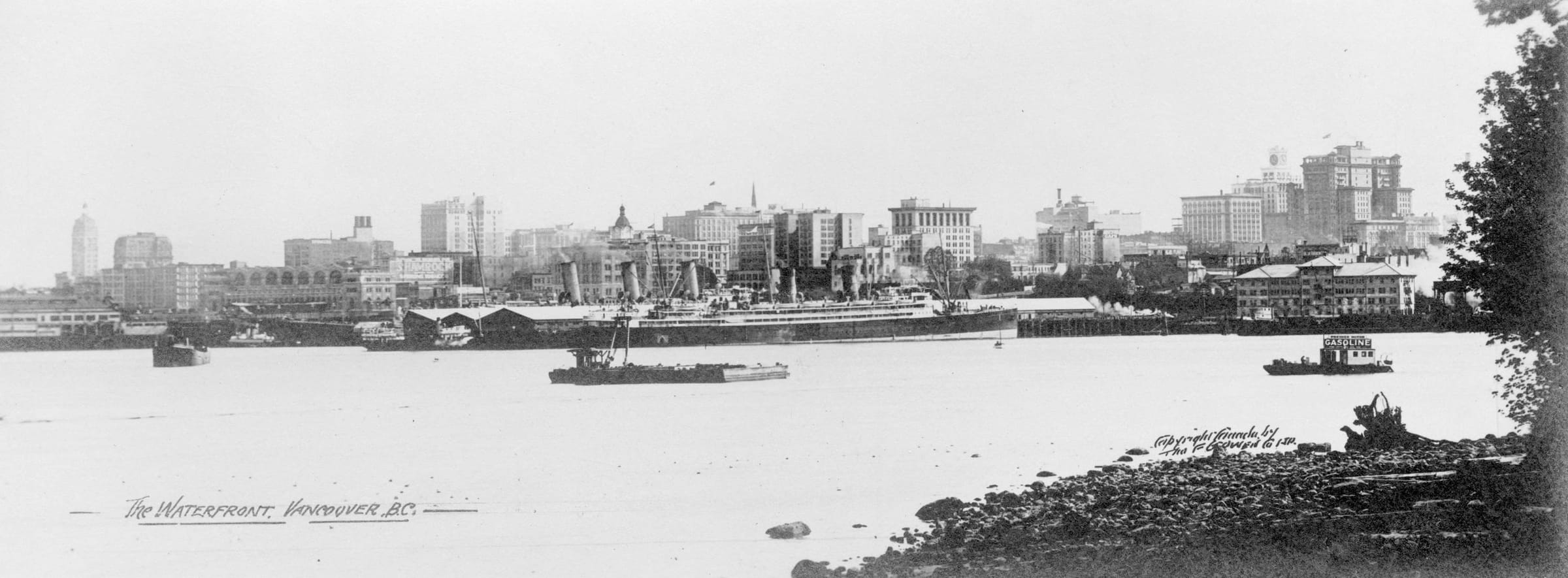
Vancouver exists because the Canadian Pacific Railway chose Burrard Inlet as its western terminus in the 1880s: a deep, ice-free harbour with a shorter Great-Circle route to East Asia than the California ports to the south. The railway built the street grid, sold the land, and carried the people — including a 22-year-old Welsh contractor named Jonathan Rogers on the first transcontinental train in 1887.
By 1911 the city was booming on lumber, salmon, minerals, shipping, and real estate. Granville and Pender sat at the financial heart of it: banks, brokers, shipping lines, and professional offices, a block from the harbour that paid for it all. When Rogers filed his permit that May, the city’s building permits for the year were climbing toward $20 million.
The boom broke in 1913, and the First World War froze what was left. But the towers it raised — Dominion, Sun, Vancouver Block, Rogers — remained, and for half a century they simply were downtown Vancouver.
The Concrete Revolution
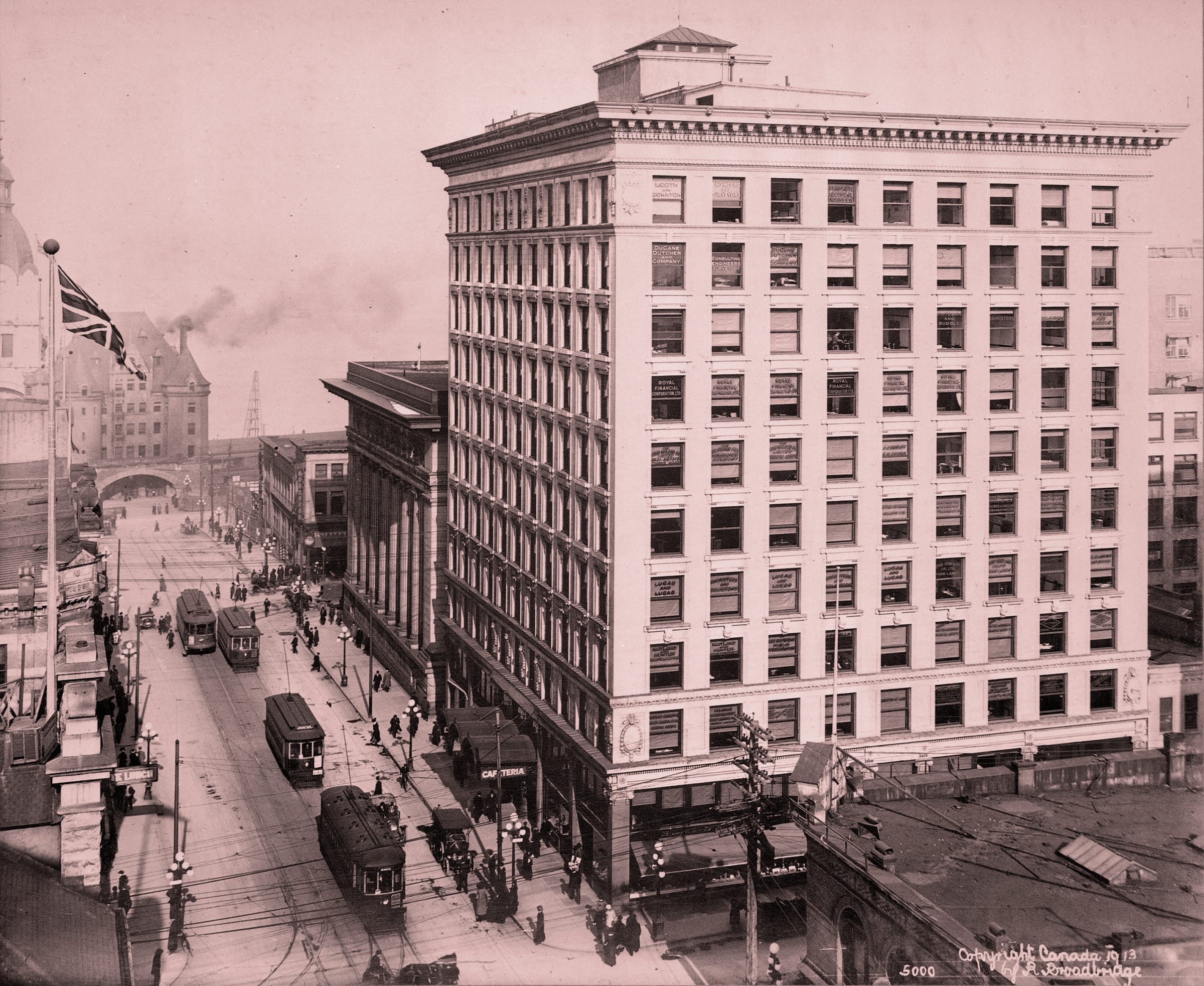
Reinforced concrete — poured around steel — let buildings rise faster, resist fire better, and span wider than masonry ever could. Gould had built early steel-and-concrete high-rises in Seattle, and Purdy & Henderson had been structural engineers on Manhattan’s Flatiron Building. In 1911 they brought that technology to a Vancouver corner.
The frame went up in under nine months. The Daily Province called it “the latest ideas of reinforced concrete construction and the first ten storey of its kind in Canada.” A city whose entire wooden downtown had burned in well under an hour in 1886 was now building itself fireproof, ten storeys at a time.
Built by the Boom
Aberdeen, Scotland → Vancouver
Monumental Ionic columns and pilasters at the ground floor
Granite shipped across an ocean announced permanence — and showed how far the young port city’s trade networks reached.
One corner, three continents: the Rogers Building is the port city’s trade routes made physical.
The Skyline of 1912
Vancouver’s identity was shaped by terracotta, granite, and steel cornices long before the condo skyline. Some of that generation survives. Some doesn’t.
Second Empire / Commercial
The first of the boom’s high-rises, at Hastings and Cambie.
Compare its painted steel frame and mansard crown with the Rogers Building’s concrete frame and steel cornice.
Edwardian Commercial
The first ten-storey reinforced concrete structure of its kind in Canada.
A contractor’s monument: engineering first, ornament in service of confidence.
Edwardian Commercial
A sibling landmark of the same boom, crowned by its clock tower — and the companion website to this one.
Two 1912 answers to the same question: how does a building announce confidence?
Beaux-Arts
Built for the World newspaper and said at the time to be the tallest building in the British Empire.
Compare visibility strategies: a copper dome versus a light well and a carved name.
Edwardian Commercial
The boom’s most beloved terracotta landmark at Georgia and Granville.
What was lost — and why heritage designation exists.
Boom & Bust
The Rogers Building was finished in 1912, at the very crest of the wave. Within a year the boom broke.
Vancouver’s building-permit values topped roughly $19 million in 1912 and collapsed to under $1 million by 1915. The Rogers Building was finished just before the tide went out.
The Rogers Building was confidence poured in concrete: a contractor who arrived on the first train, betting his fortune that the young city would keep rising around him. It did — eventually far above his cornice. That the building still holds its corner, and that a new tower stepped back so we could keep seeing it, is the boom’s best epilogue.