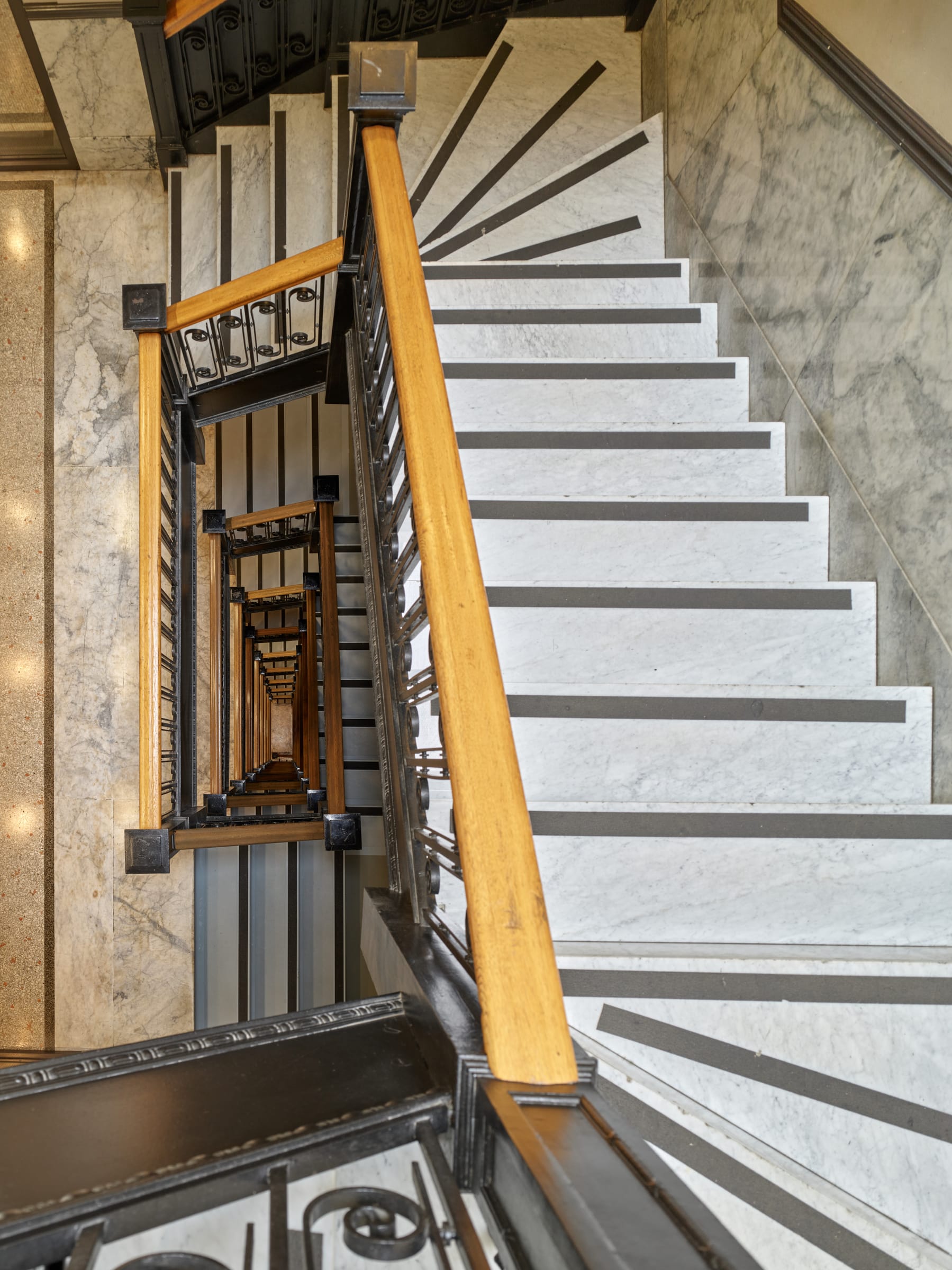
Looking down the marble stairwell of the Rogers Building

Lives of the Building

Buildings collect people.

An immigrant builder who stepped off the first train into a brass band’s welcome. A founder of the city’s art gallery and symphony. A one-armed adventurer who bought the whole block. One address.

The Cast

Builders, founders, adventurers, architects, engineers.

Filter the cast of the Rogers story — every one of them verifiable, most of them barely believable.

The Immigrant Builder

Jonathan Rogers

1865–1945

Builders

Welsh-born and, by the family’s account, raised speaking only Welsh, Rogers arrived on Vancouver’s first transcontinental passenger train in 1887 and built his fortune — and his monument — on the corner of Granville and Pender.

  • Arrived on Vancouver’s first train, 1887
  • Nine years chairing the Park Board
  • Twice president of the Board of Trade
  • Namesake of Jonathan Rogers Park

The Cultural Founder

Elisabeth Rogers

m. 1902

Founders

Jonathan’s partner in business and civic life, Elisabeth Rogers helped keep the Rogers Building in the family — foreclosing on One-Arm Sutton’s mortgage in 1938 and later steering its sale to the Koerner Foundation.

  • Partner in Jonathan’s civic life
  • Foreclosed to save the building, 1938
  • Sold to the Koerner Foundation, 1955
  • Namesake of a Mount Pleasant garden

The Adventurer

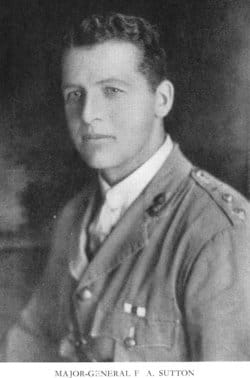
Maj. Gen. Francis Arthur "One-Arm" Sutton, M.C.

1884–1944 · owner 1927–1940

Adventurers

He earned the Military Cross at Gallipoli, chased gold in Siberia, armed a Chinese warlord, and bought the Rogers Building — reportedly, the story goes, because the manager wouldn’t renovate his office.

  • Military Cross at Gallipoli
  • Major general to a Chinese warlord
  • A gold fortune made and lost in Siberia
  • Bought the Rogers Building, 1927

The Self-Made Architect

Augustus Warren Gould

c. 1871–1922

Architects

Nova Scotia-born and never formally trained, Gould came up through building and contracting in Boston before establishing his Seattle practice in 1905.

  • Practice in Seattle from 1905
  • Early concrete-frame high-rises
  • Partnership with Champney, 1909–1912

The Beaux-Arts Hand

Édouard Frère Champney

1874–1929

Architects

Harvard and the École des Beaux-Arts in Paris; a draftsman with Carrère & Hastings; a designer on a string of great world’s fairs. Champney brought the French Renaissance polish to the partnership.

  • École des Beaux-Arts, Paris
  • Designer on four world’s fairs
  • Chief of design, Panama-Pacific Expo 1915

The Supervising Architect

Albert Gardener Wood

1886–1973

Architects

Wood moved to Vancouver to run Gould & Champney’s local office and supervised the Rogers Building’s construction — keeping an office in the finished building.

  • Supervised construction on site
  • Office in the finished building
  • Later: Henry Ford Hospital, Detroit

The Engineers

Purdy & Henderson

active 1890–1944

Engineers

The New York engineering firm behind the Flatiron Building and the Metropolitan Life Tower poured the Rogers Building’s pioneering concrete frame.

  • Engineers of the Flatiron Building
  • Offices from Boston to Havana
  • Frame complete in under nine months

The Adventurer · In Nine Episodes

The saga of One-Arm Sutton.

The building’s second owner (1927–1940), Major General Francis Arthur Sutton, M.C., lived a life that reads like pulp fiction — except that the papers reported it as news.

  1. An engineer abroad

    By his own account an engineer chasing adventure, Sutton is sub-contracting on railways and bridges in South America and working in Mexican oil refineries by the age of twenty.

  2. Gallipoli

    He lands with golf clubs labelled as surveying gear. His Military Cross citation records that he repeatedly threw enemy bombs back at great personal risk; by his own account one exploded and took his right hand — earning him a nickname to go with the medal.

  3. The Inventions Department

    Assigned to the Army’s Inventions Department of the Ministry of Munitions, he improves the trench mortar — and, he wrote, insisted on testing his designs himself at the front.

  4. Siberia

    Chasing gold, he ships in a cargo that, by his own memoir, included 10,000 pairs of shoes, 700 tons of nails, and 50 tons of horseshoes — makes a fortune, and then loses it, along with the remainder he speculates away in Shanghai.

  5. China

    Bankrupt, he builds a production line for the Stokes mortar and sells it at great personal risk — rising to major general and advisor to the warlord Zhang Zuolin.

  6. Shanghai

    Rich again, he lives large in Shanghai — the era of his life, as he told it, of racehorses and fortunes as easily lost as won.

  7. Vancouver, 1927

    He arrives with a fortune and a plan to open the Peace River country with a railway to Edmonton. He buys the Rogers Building — reported as the city’s largest real estate deal to date — reportedly in part because the manager had refused to renovate his suite of offices.

  8. Portland Island

    He buys an estate on Portland Island, meaning to build a resort with a golf course and raise thoroughbred horses — one more grand scheme for a man who never ran short of them.

  9. The crash

    The railway never materializes; the 1929 crash takes the rest. Elisabeth Rogers forecloses in 1938, and the building returns to Jonathan Rogers in 1940.

Major General Francis Arthur 'One-Arm' Sutton
Major General F.A. “One-Arm” Sutton. Image rights unconfirmed — to be verified before publication.

The Offices Upstairs

A century of tenants.

Jewellers, consuls, tailors, historians — the working life of the building is its own biography.

  • O.B. Allan Jewellers1912 – 1980s

    Held the southeast corner storefront from opening day for nearly seventy years.

  • The Chinese Consulateearly 20th century

    Maintained offices in the building.

  • Sorensen’s Cafeteriafrom 1912

    Operated in the basement — its sidewalk CAFETERIA sign is visible in the 1913 photograph.

  • Dunn’s Tailors1995 – 2020

    Known for an Art Deco neon sign dating from 1946.

  • Donald Luxton & Chuck Davis1990s

    The heritage consultant and the city’s great popular historian both kept offices here.

At capacity, more than 1,000 people worked here each day, and 18,000 passed through the bronze doors.